Sunday, 7 February 2010

Stage 3, Leg1: Bariloche to Futaleufu


The bad weather was back so we left Bariloche in see-your-breath cold, under a low sky and through a constant drizzle of rain. Despite this, the scenery was amazing and the road was perfect. We cycled a smooth paved route through deep valleys alongside gun-metal grey lakes. The mountains were high and snow-capped and we could occasionally view the glaciers of Tronador, the mountain we had trekked a few days before. The rain and mist completely changed the atmosphere of the scenery; the lakes and rivers were no longer inviting but looked moody and dark.
Besides the usual climbs, the road was predominantly downhill and we enjoyed long stretches of fast free-wheeling as we approached the next town, El Bolson. We expected big things from this town because other travellers had spoken so highly of it's laid back atmosphere, and even the Lonely Planet described it as 'a refreshing antidote to Bariloche's relentless commercialism'. It's famous for being a hippie hang-out since the seventies, and for it's amazimg artisanal food and beers. The food and beers were amazing, some of the best we've had, but the hippies were a let-down; just the usual middle-class trustafarians from the cities, slumming it for the summer, smoking roll-ups and juggling. Catherine said that hippies were 'her people', but she says the same thing about Indians so I don't believe her. The best thing about the place by far were the family-sized portions of home-made cakes, the fresh breads filled with lamb stew, and the 'taster selections' of micro-brewery beers, where you get a half pint of everything on the menu. Lovely.

The countryside around El Bolson is stunning and the next town slightly to the south was possibly what Bolson used to be before it became commercialised in it's own way; sleepy, picturesque and no bloody hippies. After a long up-and-down ride through the mountains, Ruta 40 bends sharply to the east and leaves the mountains behind for open praerie. This is the land that Butch Cassidy and the Sundance Kid settled in after escaping the States, and it looks (in places), every bit like the wild west. With the flatter terrain however, came the wind, and we struggled initially with fierce gusting cross-winds that blow you off the road one minute and under a passing truck the next. There was one stretch however, where we were amazingly lucky; the wind was square in our backs and the road was straight, well paved and with a slight downhill gradient. Even on flat ground, without peddling, the wind would push you along at about 40-50km/hr. We saw a little more of Argentina's wildlife, more armadillos and even a skunk. All dead, flattened by the traffic. We've even seen plenty of dead birds at the roadside, the most confusing scene was way back on day four of the whole trip when we saw a dead cow lying next to a dead condor. If, like me, you've ever wondered who would win in a fight between a cow and a condor, there's your answer: it's a dead heat.
After a while the praerie got a bit dull though (no wonder Butch and Sundance went back to robbing), and the tailwind became a headwind. We had optimistically hoped to reach Esquel, 160km from Bolson, but we stopped about 25km short and camped in the desert, under a bridge, lulled to sleep by the sound of trucks thundering overhead.
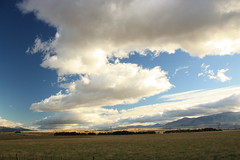

The wind raged all night but we woke to an amazing sunrise, and the journey to Esquel was quick and painless. We passed through Esquel, only stopping for supplies, and headed for Trevelin, the furtherst west Welsh settlement in Argentina; they landed on the Atlantic coast, settled Puerto Madryn and Trelew before heading west up the Chubut river towards the Andes. The result is an entire valley bisecting Argentina where everybody speaks Welsh. Just as the Swiss settled in the mountains and Butch and Sundance settled on the praerie, aspects of the countryside that we were cycling through looked spookily similar to the black montains. The rainy day helped to hide the more incongruous snow-capped 2000m peaks. In the town, the streets have names like Davies and Jones, the buildings look out of place for Argentina, and there are tea-houses everywhere. We stayed for the night in one of the nicest hostals we've ever seen, on a hill overlooking town, and went straight out for the famous Welsh afternoon tea. Catherine was in her element with a four-pinter pot of loose-leaf tea (apparently the Welsh are 'her people' too), and a selection of home made cakes, scones and jams. Trevelin and it's tea houses are a bit like a living museum where they out-Welsh the Welsh; people really do speak the language here, but it was a nice litle reminder of the UK, so we weren't complaining.


The sunrise the following morning and the clearer skies made me realise that we'd been a bit unkind in describing Trevelin as 'a bit like Wales'; Once the clouds had lifted to reveal the full mountain range, the town and the surrounding countryside is absolutely spectacular. I would happily own a sheep farm here (although possibly not as happily as a Welshman).
A short distance south of town the road heads west into the Andes and our pass into Chile became visible through the higher mountains. The weather got bad enough to distract Catherine from the road and she fell again, this time breaking the lugs holding her rear rack to the bike. Catherine was fine but the break is a serious problem; without the rear racks we have no way of carrying anything significant on her bike - I'm beginning to think that the falls are pre-meditated. We patched it up with cable ties and duct tape and headed for the border post.
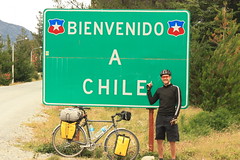
As expected, the Argentine military post couldn't care less that we were leaving for Chile, whereas the Chilean border guards were a different story. They are paranoid about pests, and therefore have very tight controls on the importation of fruit. We dutifully declared two bananas, two apples, an orange, some very nice but very dangerous unpasturised artisanal cheese and a chorizo. We were told to eat the lot or loose it, so we joined the little group of people having a fruit picnic at the border. Some poor old guy was carrying loads of food for a party and ate the lot out of principle, staring defiantly at the border guard whilst he ate a whole bag of prunes, 10 plums, and countless apples and oranges.
We met a nice Canadian tourer called James at the border so we cycled into Futaleufu with him to look for accommodation and to try to book a rafting trip for the following day. The scenery changed almost instantly as we entered Chile and we began to see the first hints of the rainforests that we expect further to the south. In the town square we also met another tourer from Spain called Joan who had arrived in Argentina to climb Aconcagua. When he came back down he decided not to be a backpacker and instead bough a bike to cycle to the south of the country. James decided to continue south as it was still early, but we stayed in town with Joan to camp for free in the back yard of the rafting company that was going to guide us down 'The Terminator' the following day. The Rio Futaleufu is world-famous for it's rapids and draws rafters and kayakers from all over the world. The river includes class VI rapids, only accessible to guides and professionals, but you can take to the river as a punter and raft the class IV+ and V's, the fastest water available to non-guides. Me and Joan signed up for the full day for a trip taking in rapids called, 'The Terminator', 'Son of Terminator', The Khyber Pass', and 'Asleep at the Wheel'.

To prepare for the day ahead we went out for a drink, but Futaleufu is a sleepy mountain town with not too many options. Our first choice was shut so we looked around until we saw some lights and heard music coming from a bar called 'Scorpions'. The curtains were drawn and the door was locked. We knocked and a lady opened the door, just a bit, looked us up and down and asked what we wanted. We said beer, she thought about it, looked us up and down again, and let us in. It was dark, full of smoke and cowboys, yet only a few exotically made-up women. There was also a huge screen playing the DVD of a Chilean band singing love songs to girls dancing in bikinis and cowboy boots. We were in a brothel. It was however the only place serving beer, and apart from the occasional request for a dance with Catherine, we were left to ourselves, so we stayed for a very interesting evening. Drinking in a Chilean brothel is now well and truly ticked off our 'list of things to do before you die'. Next up is riding a monkey.

Thursday, 4 February 2010

Bike Stuff

Warning: For bike people only and will bore eveyone else to death

Before leaving Bariloche we had some major maintainance to do to the bikes because of falls, crashes, the weather, or just wear and tear from the terrible roads. After more than 2500km, we had to completely replace the drivetrains for both bikes; so new cassettes, chains and chain rings. My rear tyre was completely bald so I replaced this with something with a bit more tread. Argentinos are always asking why we are using 'road bikes', because they only really use mountain bikes. The shops don't seem to sell tourers like ours, so anything with drop handlebars and slightly thinner tyres is just classed as a road bike. 27inch wheels are not common here either, and presta valves are even rarer, so it has been almost impossible to get spare inner tubes, and the search for a new tyre (suitable for touring) required one to be sent from another town. Another rarity in South America are front racks; For such a popular sport here, we can't understand why tourers seem to rely solely on the rear pannier bags and an oversized bar bag. They always complain that the bike is overloaded to the rear and we know that you can fit a front rack to bikes with suspension forks. As a result, I have had to settle for a temporary 'fix' for my front racks as the queue for aluminium welding in Bariloche is days long. For this same reason we specifically bought steel bikes, but we should have thought more about the components that we fitted; every little town here has someone able to weld steel, quickly and cheaply. The rest of the maintainance work was just tightening brake cables, re-aligning the gears and true-ing wheels.

Wednesday, 3 February 2010

Bariloche

Bariloche isn't so bad. It's by far the most expensive place we've seen here, and the rustle of Gore-Tex can be deafening, but it has the best bike and camping shops, and even a cinema showing films in English! More importantly, it has a choice of restaurants for my birthday. We opted for a hobbit's house, built from large stones but surfaced entirely in cypress wood, complete with a tree poking through the middle of the restaurant. The food and wine was amazing so Catherine was forgiven for not buying me a present. Catherine had offered to buy me a massage, but the only place that we have found so far is an underground parlour with a flyer girl in the doorway (a bit like in Soho), a sign showing a sultry girl in a bikini, and when we went downstairs the only staff at the time were two bored looking guys wearing women's clothes. Catherine wasn't keen but I may go back.


We decided to do a 3 day trek to mark my birthday instead. Since Slovenia, we have wanted to do another refugio to refugio trek because you don't have to carry a tent, and you can eat goulash and thick soups around a wood-burning stove on a mountain. We decided to head for Volcan Tronador, the highest mountain in the area, because you can walk to 2100m between two advancing glaciers, and you can continue on to a valley where some Australian friends had seen chinchillas. The morning we left for the park the weather was awful and just got worse as we got closer to the start point. You couldn't see the mountains through the clouds and the rain was constant. The icing on the cake was when the park ranger said that he was closing the trails because of snow higher up the mountain. All we could do was a short and crowded low-level valley walk and sleep at the refugio by the rangers office. A few other hikers were stuck in the same predicament so we chatted, had dinner and a few beers around a wood-burning stove ... so it wasn't all bad. The main problem was that we had lost a day of the trip and had no way of contacting our hospedaje in Bariloche to let them know that we wanted to postpone the reservation. I had tried to convince the ranger that this was an emergency warranting the use of his emergency radio. He said it wasn't. Catherine was impressed by the Park Ranger's powers and thought that his must be the best job in the world; sitting around in his hut in the middle of a beautiful park, drinking tea by a stove, occasionally closing a pass or two. She even said to the man, in a rather creepy way, 'you have a lot of power, don't you?' Even he looked uncomfortable because she kept looking at his gun.


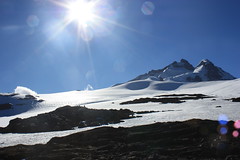
The weather the next day was much better, and just improved throughout the day. The ranger had opened the passes and we had the best walk of the trip so far. It began following milky rivers flowing along forested valley floors, before rising up the steep valley walls to a high ridge. We followed the ridge until we left the tree-line, passed the snow-line and continued over more volcanic rubble and snow until we got to the basic-looking hut high on the mountain. Throughout the walk up you can hear occasional rumbles of thunder; this is the end of one of the glaciers breaking off and falling 300m from the ridge to the valley floor below (Monte Tronador means 'Thunder Mountain'). Because of the movement of the glaciers, the eastern side of the mountain reaches the valley floors via a series of vertical steps, hundreds of metres high. Each step links a series of waterfalls, sometimes so high that the water turns to mist before reaching the floor. Really spectacular. We arrived at the refugio early in the afternoon, just in time to see a parascender leap off the side of the ridge. we felt jealous because he had an amazing flight right over the huge glacier to the North of the refugio. Presumably because of the temperature maintained by the glaciers, the refugio staff were also able to ski during the day as well. 'Park Ranger' had just been overtaken by 'Refugio staff' as the best job in the world. We met another English couple at the hut called Catherine and John so we took a break from mangling Spanish and had a great afternoon walking about in the snow and sunbathing because the clouds had all cleared, and it was quite warm despite the snow. The hut has an awesome position on the side of the mountain, higher than most of the surrounding mountains, so we were able to see for miles in every direction. The sunset and moonrise were awesome too. When the sun did set and the temperature dropped, we went inside the refugio for a few beers and a steak dinner by the fire. The refugio staff were amazing, and made a beautiful dinner for about 50-60 people in a tiny kitchen, and then accommodated everyone for the night in one huge room in the roof. Admittedly, the accommodation was basic ... quite literally just 40 single mattresses shoved together to cover the entire floor, and then everyone was assigned their personal 75 percent of a mattress. I spent a cosy night, rolling about well beyond the boundaries of my 75 percent, sometimes cuddling Catherine, and sometimes other people. Sorry John.


We descended the next day and sadly had to miss the 'valley of the chincillas' because of the weather delay at the start. The ranger consoled us with the news that we'd have been very lucky to have seen one anyway so maybe not all bad. When we got back to Bariloche that night we went for a drink to say goodbye to Catherine and John as they were continuing north the next day. Whilst out, I also stubbed my toe. As Catherine had found out a week earlier in San Martin, toe stubbing in South America is much more elaborate affair than back in the UK, where even unattended minors are able to take part, stubbing their toes at will. I myself had plenty of experience in stubbing my toes, so thought myself ready to tackle the worst pavements and tree roots that Argentina had to offer. Sadly, we have found ouselves to be well out of our depth here, and toe stubbing always seems to result in unsightly flaps of skin, blood pooling on the pavement, bilingual swearing, black toenails, and more betadine. Maybe even a tear.


The next day we went horse riding. Since horses always bite me I had only agreed to this if Catherine would go rafting, although I suspect she'll back out yet. We booked in with a local gaucho lady with the deceptively English name Carol, and when she picked us up, we shared the truck with two hungover cowboys from Wyoming called Tyler and Frank. Tyler was a younger guy, helping out on the ranch until some friends arrived, but Frank was purposefully in town to buy horses so that he could ride over the mountains into Chile and beyond. Frank was in his 60s and every story seemed to involve drink. Later, whilst we were out on our ride, he had drunk the horse's medicine thinking Carol was 'hiding whisky' from him! Unlike previous horse riding experiences in the UK, they first have to send gauchos out onto the ranch to 'catch' the horses (I'm sure there's a proper term for it). Carol's horses didn't even attempt to bite me so all got along fine and we had a great ride over the hills, spotting a few deer and some hares as we went, and we finished with a beer afterwards. Frank had fallen asleep under a tree but joined us for the beer. We asked Carol about the wildlife in the area and she said that, amongst other things, there were pumas. I asked what they ate, and she said 'deer and small horses'. I said that, as a camper, this worried me, but she said not to worry because 'you never see them'. I explained that this worried me more. When Carol dropped us off back in town I asked if she was going to sell a horse to Frank; She said she was, and she would like to buy the horse back at the end, but after glancing into the truck, she solemnly supposed that Frank would probably never be seen again.


We finally made use of the English cinema and saw Avatar. Catherine lost all her street-cred, and cried like a schoolgirl ... over an animated action film. Never again can she mock me for only crying at Armageddon, the powerhouse emotional rollercoaster set to an Aerosmith soundtrack. Tomorrow we leave for Stage 3 and Patagonia proper.

Wednesday, 27 January 2010

Stage 2, Leg 5: Junin De Los Andes to Bariloche

The carnival (and beer and ice cream) took it's toll the next morning and we had our latest start yet for the short trip to San Martin De Los Andes. Fortunately, we covered the 44km in just 2 hours. San Martin is bigger and more up-market than Junin, a year-round mountain resort in the vein of Banff, and we were pleased to see many 'boaty-types' with pastel sweaters tied loosely about their necks in a jaunty fashion. It also has a beautiful swimming beach so we decided to stay for a day so that Catherine could top up her tan lines, and so that I could get whistled at by the lifeguard for swimming past the buoys, set 15ft from the beach. At night our luck continued as the town was hosting a street fair that night with more clowns (bigger in Argentina than one would think), open-air art galleries, free chocolate and liqueur tastings, and even those crappy speed-landscape 'artists' (à la Bob Ross).

Whilst in San Martin we also met Mike, another English cycle-tourer, whose journey was taking him north from Puerto Montt in Chile all the way to Peru. He had an exciting soundin job at Lockheed Martin, integrating weapons systems into military helicopters. The type of work that cannot be spoken about unless he kills you afterwards. Unfortunately we had a few drinks that day with Mike and he told us all about it, so we shall be looking over our shoulders from now on. Catherine has grown a moustache just in case.

After the rest day we began the much-anticipated Ruta De Los Siete Lagos, a semi-paved route through the mountains, linking a series of beautiful lakes, waterfalls, free campsites and hitch-hikers. This route is listed as a real 'must-do' in the guide books so we have been looking forward to it since the start of the trip. The route is 115km long so we split it into two days; the first being defined by the graceful ribbon of smooth tarmac winding between imposing mountains and deep blue lakes, the second being defined by the rutted and dusty ripio road, clogged up with an endless procession of camper vans and lorries ... only their headlights visible through the permanent dustcloud. The route as a whole was still worthwhile but we should have set off even earlier than 7am to beat the trafic on the second day. The best bit was the free campsite at Lago Faulkner, where we set up camp in the middle of an old forest on the shores of the lake. We lit a campfire, had dinner, and watched the fishermen as the sun set over the lake. Incidentally, another wild camp; another lesson learned (Ray Mears didn't cover this one): never put a campfire out be weeing on it. The fire doesn't go out, and the next day your hair still smells of hot wee. The hawks were back in large numbers too, the trees were full of them, and in the morning I caught them going through the belongings of some guys sleeping in the forest without a tent. Fools.


The 'Seven Lakes Route' is also a real favourite for domestic Argentine bike tourers, so we seem to have lost some (all) of our novelty status as we roll into a town or village or campsite. Even we're bored of them; whereas we used to stifle tears at the sight of another tourer, we can now barely be bothered to raise a hand as they go by.
After the disappointing ripio section, the drop out of the mountains into Villa La Angostura was spectacular. The descent crosses a high bridge over a river linking two huge lakes, and the town itself spills down a hill to a couple of lovely wooded bays facing the snow-capped Andes. Villa La Angostura is an even fancier resort than San Martin, and you pass a string of hill-top spa hotels on the way in. Even the campsite was a cut above, complete with marble sink tops and beaten-copper washbasins. Very La De Da.


The next morning we set off on the last leg of stage 2, an 85km nicely undulating route following the north and eastern shores of Lago Nahuel Huapi, finishing in Bariloche. At just over 2500km, it is the halfway marker for our trip. The ride was a beauty, surrounded by high mountains and always within spitting distance of the 100km-long deep blue lake, fringed with some amazing beaches. Whilst we had lunch we also met Hugo and Angel (note to self: good name for a cop show), a couple of Argentine bike tourers on holiday from Buenos Aires. Hugo was an odd guy, all teeth and ears, and covered in spandex and tattoos. He would punctuate the conversation by lifting a piece of clothing, exposing another tattoo that would illustrate or emphasize his point. Even as we cycled together for a while he would still be talking, wobbling about with a sleeve rolled up or a thigh exposed.

We'd heard mixed things about Bariloche; mostly bad, and mostly complaints that it's not a Swiss-styled jewell of the mountains, but a touristy moneypit, so when we rolled into the town square and saw gypsies asking for money to have your photo taken with St Bernard pups, the signs weren't good.

Day 28: Junin to San Martin De Los Andes - 44km
Day 29: San Martin to Lago Faulkner - 56km
Day 30: Lago Faulkner to Villa La Angostura - 58km
Day 31: Villa La Angostura to Bariolche - 85km

Friday, 22 January 2010

Volcan Lanin Trek


Junin is the gateway to Parque Nacional Lanin, famous for it's 3700m volcano complete with a perfect snow-capped cone. We decided that we'd trek the 25km up to the snow line and back before we moved on, and it was an amazing walk. It was another early start to catch the bus into the park, early enough to catch the hawks going through the rubbish bags outside our tent. I'd always considered these birds to be the majestic, fearsome scourge of the skies, but here they're just fancy-plumed bums that go through your bins at night.
The walk begins with a sign warning you of some nasty-looking yellow biting flies, saying that they can cause an allergic reaction. We assume that because neither of us are allergic to bees, we'll be fine. As it turned out, we didn't pay enough attention to the photo of the insect, and convinced ourselves that the yellow biting flies that carpeted our skin throughout most of the walk were the fatal kind, and spent a lot of the walk looking like we were at a silent disco. The walk winds through dense old-growth forest, bamboo and wild horses, past rivers and streams, before breaking the tree-line into high pastures and clear glacial streams that you can drink from. Just below the snow-line the ground is littered with pumice stone in oranges and reds, and black volcanic sand. We even walked for a while with a firewoman from Buenos Aires who had the appeal of looking similar to Angelina Jolie, but the unnerving quality of reminding us both of Sarah Connor from the Terminator. She very kindly offered to take us out in Buenos Aiores when we get there; We think her casual military attire, love of motorbikes (and long list of crash stories), and part time job as road-accident photographer for the fire department make her the most interesting prospect yet.


When we got back to Junin at around midnight, we walked straight into a Carnival procession, complete with dancers, floats and clowns. We're not sure what it was celebrating (bumper trout harvest?) but it was an amazing mixture of colour, humour and noise. Think Notting Hill Carnival without the attitude, gangs and stabbings. As ever, it was a family affair with kids and babies out well past 2am, mostly darting into the procession to cover the dancers in silly string. The party carried on long after we went back to the tent, catching a glimpse of guilty beaks as we passed the bins.

Thursday, 21 January 2010

Pictures Pictures Pictures

As ever, more pictures will follow. It still takes a long time to upload as we go, and we're a bit behind, but I will be going back over some old posts to fill in the gaps. Not sure if this will reward a re-read of the posts(!) but it will brighten the blog up a bit. In the meantime here's a picture of a puppy:

Stage 2, leg 4: Lago Aluminé to Junin de los Andes


A few more sad goodbyes marked our departure from the campsite in the morning, and left us reflecting about how so much of our experience is down to pure luck. I'm not sure every set of neighbours could have been so freindly, and would have shared the same sense of humour about so many things? We circled the north and eastern shores of the lake for about 18km, passing the wooden cabins of the Mapuche people that populate the area, until we met the start of the rio Aluminé. This is a big river for both trout fishing and white water rafting; a bad mix I imagine? The scenery becomes even more alpine hereafter, complete with log cabins, and we could have almost been in the south of France approaching the Alps. This is also dairy and honey country, and it was lovely passing along lavendar-fringed roads, through shallow valleys full of farmsteads selling fresh honey, chocolate, cherries and cheese. The novelty wore off after being hit in the face by the millionth bee. It was easy to pick a perfect spot by the river to camp because they were everywhere. We settled on a secluded spot away from the road, shaded by birch trees, and with it's own 'private' sandy beach leading down to the crystal clear water. It'll take something special to top this as 'wild camp spot of the holiday'!

Unfortunately the following day was marked by long hot climbs over heavily corrugated dirt roads. We even left the river behind for most of the day. We did however bump into a couple of French cycle-tourers heading north, picking wild cherries by the side of the road. We were doing more or less the same trip in opposite directions so we swapped stories, and they warned us about the same isues as the Swiss couple; rising costs and limited availability of beds and campsites in Patagonia. They did at least say that it was breath-takingly spectacular and well worth the effort. We rolled into Junin de los Andes, absolutely knackered after 75 km of some of the worst roads we've bounced along; enough to numb your hands for hours. Mysteriously pork ribs and wine cure this condition.

Day 26: Villa Pehuenia to Rio Aluminé - 90km
Day 27: Rio Aluminé to Junin de los Andes - 75km